
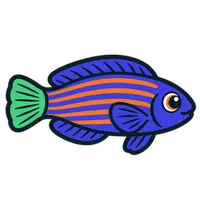
The six line wrasse (Pseudocheilinus hexataenia) is a busy, jewel-striped little wrasse that hunts pest snails, flatworms and bristleworms through the rockwork — a genuine helper. The catch: it's peaceful as a youngster but turns territorial with age, so it goes in LAST, one per tank, under a tight lid (it's a jumper).
Care at a glance
| Adult size | About 3–4 in (7.5–10 cm). |
|---|---|
| Minimum tank | ~30–55 gallons with plenty of live rock to forage through and hide in. |
| Temperature | 72–78°F (22–26°C). |
| pH | 8.1–8.4. |
| Specific gravity | 1.023–1.026. |
| Other targets | Lots of rockwork to hunt through and sleep in; keep nitrate low. |
| Diet | Carnivore — frozen mysis, brine and krill plus small marine preparations, 2–3× a day. It also hunts pests (pyramidellid “clam-parasite” snails, flatworms, bristleworms, pods) — but this varies a lot: some are voracious pest-hunters, others ignore pests once used to easy frozen food. |
| Temperament | Peaceful as a juvenile, but develops a real semi-aggressive, territorial streak with age — it harasses newcomers and fish of similar shape. Keep ONE per tank, and add it LAST, after the calmer fish are settled. |
| Reef-safe | Reef-safe with corals — but not fully invert-safe: it can pick at ornamental crabs, small starfish, clams, and desirable pods/small shrimp. |
| Natural range | Indo-West Pacific and the Red Sea. |

The fish store gets these wrong
Common myths, kindly corrected — no shame for having believed them.
- “A six line wrasse will clear my flatworms/pests.” Sometimes — but it's hit and miss. Some hunt pests voraciously; others, used to easy frozen food, ignore them. Treat pest control as a bonus, not a guarantee.
- “It's reef-safe, so it's invert-safe too.” Not quite — it's safe with corals but may pick at ornamental crabs, small starfish, clams, and desirable pods/shrimp.
- “Add it whenever.” No — add it LAST. A settled six line bullies newcomers, so it should be among the final (and to a calm, established tank).
Before you buy
- Add it LAST, once your peaceful fish are established.
- One per tank — they don't tolerate their own kind (or similar-shaped fish).
- Use a tight lid — it's an accomplished jumper.
- Give it plenty of live rock to hunt and hide in.
Quarantine and get help if…
We can't diagnose from a photo — but these are the signs to stop watching, quarantine, and get an aquatic vet or an experienced reefer's eyes on it:
- White salt-grain spots, flashing, or rapid gill-breathing (possible ich or velvet).
- Cloudy skin patches, clamped fins, or gasping at the surface.
- Hiding and refusing food for days, or a hollow belly.
- Any new fish added without quarantine.
Print the Six Line Wrasse emergency vet-prep card — what to bring, what to tell the vet, and the questions to ask.
Never
- Never add a six line wrasse early — it bullies later additions.
- Never keep two in one tank.
- Never run an open-top tank — it jumps.
- Never assume it'll definitely eat your pests — it's variable.
- Never add it to an uncycled tank.
Common six line wrasse questions
Is the six line wrasse aggressive?
It becomes so with age. Six line wrasses are peaceful as juveniles but develop a strong territorial streak, harassing newcomers and similar-shaped fish. The fix is simple: add it LAST, and keep only one per tank.
Will a six line wrasse eat pests like flatworms and pest snails?
Often, yes — they hunt pyramidellid (clam-parasite) snails, flatworms, bristleworms and pods. But it's variable: some are voracious, others ignore pests once used to frozen food. Treat it as a helpful bonus, not a guaranteed cure.
Is the six line wrasse reef-safe?
Yes with corals. It's not fully invert-safe, though — it may pick at ornamental crabs, small starfish, clams, and desirable pods or small shrimp.
Do six line wrasses jump?
Yes — they're accomplished jumpers. A tight-fitting lid or mesh cover is essential.
What size tank does a six line wrasse need?
About 30–55 gallons with plenty of live rock to forage through and hide in. The rock matters as much as the volume — it hunts and sleeps in the reef structure.
🐚 Did you know? — Six Line Wrasse fun facts
Little true delights about the six line wrasse — each one checked against a named source, no reef-store folklore.
- Each night the six-line wrasse tucks into a crevice and wraps itself in a mucus cocoon, thought to hide its scent from predators hunting in the dark. Wikipedia
- Six-line wrasses have been seen working as cleaner fish, picking tiny parasites like copepods and isopods off other fishes. Wikipedia
- To spawn, paired six-line wrasses make a lightning-fast dash toward the surface just before sunset, the sheer speed helping them dodge waiting predators. Wikipedia
Sources & further reading
This guide was written and fact-checked against these authorities. It's honest, general guidance — not a diagnosis, and not a substitute for an aquatic vet or your own test kit:
- Saltwater Aquarium Blog — Six Line Wrasse — adult size, tank, water, diet & pest control, temperament/add-last, reef-safe, jumping, range
- LiveAquaria — Six Line Wrasse — tank size, add-last guidance, reef compatibility, pest control
Written and fact-checked by The Coralkin Team against marine-aquarist and veterinary sources — if your six line wrasse shows a red-flag sign above, quarantine and get an aquatic vet or an experienced reefer's eyes on it. We never guess a care number.
🔬 Review status: team-written and fact-checked against cited sources · not yet reviewed by a marine vet. How we research & fact-check →
Get the free Six Line Wrasse Starter Kit
A readiness checklist and a first-30-days plan to set up your six line wrasse the right way — every number drawn straight from our fact-checked care sheet. Join the shoal and we’ll send it over.
Honest reef care straight to your inbox. No spam — unsubscribe anytime. See how we handle your data in our privacy notice.