
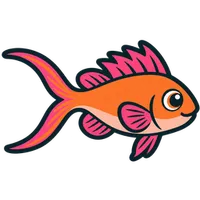
Lyretail anthias (Pseudanthias squamipinnis) are the shimmering orange-and-pink fish that fill the water column in every dream reef photo. They're stunning and active — but they come with real commitments: planktivores with fast metabolisms that need feeding several times a day, and shoaling harem fish that want a group (one male, several females) in a big tank.
Care at a glance
| Adult size | ~3–5 in (males larger). |
|---|---|
| Minimum tank | A single is possible in ~70 gallons, but a proper harem wants 125+ gallons with open swimming water and strong flow. |
| Temperature | 75–82°F (24–28°C). |
| pH | 8.1–8.4. |
| Specific gravity | 1.023–1.026 (reef-standard ≈35 ppt). |
| Diet | Planktivore — needs small meaty foods (mysis, enriched brine, finely chopped seafood, pellets) fed SEVERAL times a day. This is the make-or-break of anthias care. |
| Temperament | Peaceful and social — a shoaling harem fish (one dominant male, several females). Females can squabble as a pecking order forms. |
| Reef-safe | Yes — completely reef-safe; it eats plankton from the water, not corals or inverts. |
| Natural range | Indo-Pacific. |

The fish store gets these wrong
Common myths, kindly corrected — no shame for having believed them.
- "Feed it once a day like other fish." Anthias have fast metabolisms and need several small feeds a day — underfeeding is the number-one reason they waste away.
- "Buy a group of any anthias." A group means ONE male and several females — two males will fight, and a lone female may become male over time. Plan the harem, and give it a big tank.
Before you buy
- A commitment to feed several times a day (an auto-feeder helps).
- A big tank (125+ gal) for a harem, with open water and strong flow.
- One male plus several females — never two males (in a normal tank).
- Quarantine before adding.
Quarantine and get help if…
We can't diagnose from a photo — but these are the signs to stop watching, quarantine, and get an aquatic vet or an experienced reefer's eyes on it:
- Thinning or a pinched-in belly despite feeding — under-fed or out-competed; feed more, more often.
- White spots, rapid breathing or flashing — quarantine and treat.
- Hiding and not swimming in the open — stress, bullying, or poor water quality.
Print the Lyretail Anthias emergency vet-prep card — what to bring, what to tell the vet, and the questions to ask.
Never
- Never keep anthias on one feeding a day — they starve.
- Never keep two males in a normal tank — they fight.
- Never add them to a small or low-flow tank — they need open water.
Common lyretail anthias questions
How often do lyretail anthias need feeding?
Several times a day — typically two to four small meaty feeds. They're planktivores with fast metabolisms, and underfeeding (a once-a-day routine) is the number-one reason anthias slowly waste away. An automatic feeder or a pod-rich refugium helps a lot.
Do I have to keep anthias in a group?
They're happiest as a harem — one male and several females — but a single fish also does fine and avoids the aggression a group can bring. What you must avoid is two males in a normal tank, which leads to fighting.
How big a tank do lyretail anthias need?
A single can work in around 70 gallons, but a proper harem wants 125 gallons or more, with open swimming water and strong flow to mimic the current they feed in.
Are lyretail anthias reef-safe?
Completely — they pick plankton from the water column and never bother corals or inverts. They're one of the best fish for adding motion to a reef.
Do anthias change sex?
Yes — they're born female, and in a group the dominant fish becomes the male. That's why you keep one male with several females; if the male dies, a top female will usually transition to replace him.
🐚 Did you know? — Lyretail Anthias fun facts
Little true delights about the lyretail anthias — each one checked against a named source, no reef-store folklore.
- Lyretail anthias are protogynous hermaphrodites living in harems, so when the territorial male dies the largest dominant female slowly transforms over weeks or months into the new male. Wikipedia
- These fish gather in large aggregations above coral outcrops and reef slopes, drifting in the current to feed on zooplankton. FishBase
- Males and females look so different they were once mistaken for separate kinds of fish, with pink females reaching about 7 cm and the fuchsia males growing to twice that with a long trailing dorsal ray. Wikipedia
Sources & further reading
This guide was written and fact-checked against these authorities. It's honest, general guidance — not a diagnosis, and not a substitute for an aquatic vet or your own test kit:
- Saltwater Aquarium Blog — Lyretail Anthias — feeding, harem, tank size
- AquariumStoreDepot — Lyretail Anthias Care — feeding frequency, social structure
- Reef Chasers — Lyretail Anthias Care Guide — care, reef-safe, diet
Written and fact-checked by The Coralkin Team against marine-aquarist and veterinary sources — if your lyretail anthias shows a red-flag sign above, quarantine and get an aquatic vet or an experienced reefer's eyes on it. We never guess a care number.
🔬 Review status: team-written and fact-checked against cited sources · not yet reviewed by a marine vet. How we research & fact-check →
Get the free Lyretail Anthias Starter Kit
A readiness checklist and a first-30-days plan to set up your lyretail anthias the right way — every number drawn straight from our fact-checked care sheet. Join the shoal and we’ll send it over.
Honest reef care straight to your inbox. No spam — unsubscribe anytime. See how we handle your data in our privacy notice.