
Kenya Tree Coral
Capnella spp.
The bulletproof beginner tree coral — so hardy it can spread; a great first coral, kept in check.
Difficulty: Beginner Soft coral (beginner)
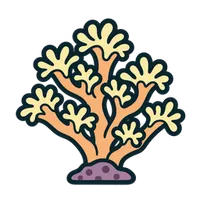
The Kenya tree coral (Capnella spp.) is the coral you almost can't kill — a soft, bushy "tree" that pulses gently and shrugs off conditions that would sulk other corals. That hardiness is also its catch: it grows fast and drops little branches that root and grow into new trees, so in a happy tank it can spread like a weed. A brilliant, cheap first coral — kept in check.
Care at a glance
| Colony / form | A soft, branching tree of polyps; droops by day, puffs up to feed. |
|---|---|
| Lighting | Low to moderate (≈80–250 PAR) — very adaptable. |
| Water flow | Moderate — it sways and sheds waste in decent flow; bottom-to-mid placement. |
| Placement | Lower or mid rock, ideally on its own island of rock — it spreads by dropped branches, so keep it off shared rock. |
| Temperature | 75–82°F (24–28°C). |
| pH | 8.1–8.4. |
| Specific gravity | 1.023–1.026 (reef-standard ≈35 ppt). |
| Other targets | Soft corals don't draw down calcium and alkalinity like stony corals — just keep salinity and the usual reef parameters stable. |
| Feeding | Photosynthetic; benefits from the general food in the water — no target-feeding needed. |
| Growth & spread | Fast — and it propagates itself by dropping branchlets that settle and grow (can become invasive). |
| Natural range | Indo-Pacific. |
The fish store gets these wrong
Common myths, kindly corrected — no shame for having believed them.
- "It's drooping, so it's unhealthy." Kenya trees naturally droop and look deflated at times (especially by day), then puff up — it's normal, not a sign of trouble.
- "Soft corals grow slowly." Kenya tree can spread fast and become weedy by dropping branchlets — great for a new tank, but keep it contained.
Before you buy
- Its own rock island (it spreads by dropped branches).
- A willingness to prune it back so it doesn't crowd other corals.
- Any decent light and moderate flow — it's very forgiving.
Signs something's wrong
A struggling coral is almost always telling you about light, flow or water — here's what to watch for:
- Staying shrivelled and not puffing up for days — check water (it takes a lot to bother a Kenya tree).
- Tissue rot or melting at the base — a real problem; cut to healthy tissue, re-attach, and check water.
- Spreading over other corals — prune the branchlets; it's competing for space.
Work through the Kenya Tree Coral trouble card — the water, light, flow and pest checks that fix almost every struggling coral.
Never
- Never assume drooping means dying — it's normal for this coral.
- Never plant it on shared rock if you want a tidy reef — it spreads.
- Never let dropped branches root among prized corals unchecked.
Common kenya tree coral questions
Is the Kenya tree coral good for beginners?
It's one of the best — arguably the hardiest coral in the hobby, tolerant of low light, moderate flow and imperfect water. It's a brilliant confidence-builder; the only catch is that it grows fast and can spread.
Why does my Kenya tree look droopy and deflated?
That's normal — Kenya trees naturally droop and shrink at times (often during the day) and puff back up later. It's not a sign of illness unless it stays shrivelled for days alongside other warning signs.
Does Kenya tree coral spread or become invasive?
It can — it grows quickly and propagates by dropping small branchlets that settle and grow into new colonies. Give it its own rock island and prune strays so it doesn't crowd other corals.
How much light does a Kenya tree need?
Not much — low to moderate light (roughly 80–250 PAR) suits it, and it adapts to a wide range. It's genuinely forgiving.
Do I need to feed Kenya tree coral?
No target-feeding required — it's photosynthetic and takes what it needs from light and the food already in the water.
🐚 Did you know? — Kenya Tree Coral fun facts
Little true delights about the kenya tree coral — each one checked against a named source, no reef-store folklore.
- Kenya tree corals are soft corals that form thick trunks and branches closely resembling little trees. Wikipedia
- Their colour is tuned by the light, growing paler in bright light and darker in dimmer conditions. Wikipedia
- In stronger currents Kenya tree corals reshape themselves into flatter colonies with shorter branches. Wikipedia
Sources & further reading
This guide was written and fact-checked against these authorities. It's honest, general guidance — not a diagnosis, and not a substitute for an aquatic vet or your own test kit:
- Saltwater Aquarium Blog — Kenya Tree Coral Care — hardiness, light, spreading
- AlgaeBarn — ORA Capnella Kenya Tree — aquacultured, care
- Reef Chasers — Kenya Tree Coral Care — placement, flow, propagation
Written and fact-checked by The Coralkin Team against marine-aquarist sources — if your kenya tree coral is struggling, it's almost always a light, flow or water-chemistry issue — check those first and ask an experienced reefer. We never guess a care number.
🔬 Review status: team-written and fact-checked against cited sources · not yet reviewed by a marine vet. How we research & fact-check →
Get the free Kenya Tree Coral Starter Kit
A readiness checklist and a first-30-days plan to set up your kenya tree coral the right way — every number drawn straight from our fact-checked care sheet. Join the shoal and we’ll send it over.
Honest reef care straight to your inbox. No spam — unsubscribe anytime. See how we handle your data in our privacy notice.