
Green Star Polyp
Pachyclavularia violacea
A neon-green carpet that grows like wildfire — hardy, cheap, and beginner-proof.
Difficulty: Beginner Soft coral (beginner)
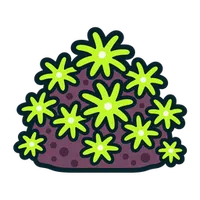
Green star polyps (GSP) are a neon-green carpet of polyps on a purple mat — one of the hardiest, fastest, cheapest corals you can buy, and a brilliant first coral. The catch is the same thing that makes it easy: it grows so aggressively it will encrust and overgrow everything unless you isolate it.
Care at a glance
| Colony / form | An encrusting purple mat studded with neon-green polyps; spreads across any surface it touches. |
|---|---|
| Lighting | Very adaptable — from dim to bright; a medium ≈150–250 PAR is ideal. One of the least light-fussy corals. |
| Water flow | Flexible — it does well in moderate-to-strong flow, which also helps keep algae off its mat. |
| Placement | Anywhere it has a surface to encrust — but on an ISOLATED rock or island, not touching your main rockwork. |
| Temperature | 75–82°F (24–28°C). |
| pH | 8.1–8.4. |
| Specific gravity | 1.023–1.026 (reef-standard ≈35 ppt). |
| Other targets | Very tolerant of chemistry swings — no dosing needed. Keep it stable. |
| Feeding | Photosynthetic — no feeding needed; light does the work. |
| Growth & spread | Very fast and encrusting — it grows over rock, sand, glass and other corals in any direction. Contain it on its own rock with a gap, or it takes over the tank. |
| Natural range | Indo-Pacific reefs. |
The fish store gets these wrong
Common myths, kindly corrected — no shame for having believed them.
- “GSP is reef-safe, so it's harmless to my other corals.” Not quite — it's peaceful chemically, but it physically encrusts and smothers neighbours by growing over them. Isolation, not compatibility, keeps the peace.
- “If it closes up, it's dying.” Often it just sulks for days after a move or a parameter change, or if detritus settles on the mat — give it time and flow; it's very hard to actually kill.
Before you buy
- Decide on an ISOLATED rock or island for it before you buy.
- Leave a bare gap between its rock and your other rockwork.
- Give it decent flow to keep its mat clean.
Signs something's wrong
A struggling coral is almost always telling you about light, flow or water — here's what to watch for:
- Polyps staying closed for more than a few days — usually a recent move, a parameter swing, or detritus on the mat; increase flow and wait.
- The purple mat lifting/peeling from the rock — re-secure it; it re-attaches readily.
- It's creeping onto neighbouring corals — trim/peel it back and widen the gap (management, not illness).
Work through the Green Star Polyp trouble card — the water, light, flow and pest checks that fix almost every struggling coral.
Never
- Never attach GSP directly to your main rockwork — it will spread onto everything.
- Never let it grow into slower corals — peel it back early.
- Never assume “reef-safe” means it won't smother neighbours physically.
Common green star polyp questions
How do I stop green star polyps from spreading or taking over?
Isolate it. GSP encrusts over any surface it touches, so keep it on its own rock or island with a bare gap between it and your other rockwork. If it creeps across, peel or trim it back early — that's management, not a disease.
Is green star polyp a good beginner coral?
Excellent — it's one of the hardiest, fastest, most forgiving corals there is, undemanding on light and flow. Its only real downside is how aggressively it spreads, so contain it from the start.
Why are my green star polyps not opening?
Usually a recent move, a parameter swing, or detritus settling on the mat. Give it good flow and a few days; GSP is very hard to actually kill and normally reopens.
What lighting and flow does GSP need?
It's very adaptable — it grows under almost any reef light (a medium 150–250 PAR is ideal) and does well in moderate-to-strong flow, which also keeps algae off its mat.
Is green star polyp reef-safe?
Chemically, yes — but it physically overgrows and smothers slower corals. Keep it isolated and it coexists fine; let it touch neighbours and it will grow over them.
🐚 Did you know? — Green Star Polyp fun facts
Little true delights about the green star polyp — each one checked against a named source, no reef-store folklore.
- The vivid green of many corals comes not from their algae but from the animal's own green fluorescent proteins, the same family of pigments that revolutionised biology as glowing cell markers. Wikipedia
- Corals are animals that partner with plant-like algae called zooxanthellae living inside their tissues, and it is these algae that give many corals their colour. NOAA
Sources & further reading
This guide was written and fact-checked against these authorities. It's honest, general guidance — not a diagnosis, and not a substitute for an aquatic vet or your own test kit:
- Saltwater Aquarium Blog — Green Star Polyps Coral Care — lighting, flow, invasiveness, hardiness, placement
- Tidal Gardens — Green Star Polyps — care + encrusting growth
- Reefs.com — Green Star Polyps — beginner care, spreading
Written and fact-checked by The Coralkin Team against marine-aquarist sources — if your green star polyp is struggling, it's almost always a light, flow or water-chemistry issue — check those first and ask an experienced reefer. We never guess a care number.
🔬 Review status: team-written and fact-checked against cited sources · not yet reviewed by a marine vet. How we research & fact-check →
Get the free Green Star Polyp Starter Kit
A readiness checklist and a first-30-days plan to set up your green star polyp the right way — every number drawn straight from our fact-checked care sheet. Join the shoal and we’ll send it over.
Honest reef care straight to your inbox. No spam — unsubscribe anytime. See how we handle your data in our privacy notice.