
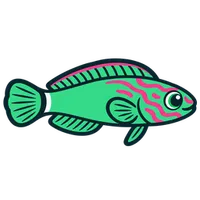
The melanurus wrasse (Halichoeres melanurus) is a rainbow-coloured livewire and one of the best natural pest-controllers in the hobby — it patrols the rock all day hunting flatworms, pyramid snails and bristleworms. It's hardy and reef-safe with corals, with three things to plan for: a fine sand bed to sleep in, a tight lid (it jumps), and the fact that it can't tell a pest snail from your prized one.
Care at a glance
| Adult size | ~5.5 in. |
|---|---|
| Minimum tank | A 55+ gallon tank with a fine sand bed (2–3 in) and plenty of live rock. |
| Temperature | 75–82°F (24–28°C). |
| pH | 8.1–8.4. |
| Specific gravity | 1.023–1.026 (reef-standard ≈35 ppt). |
| Diet | Carnivore — hunts flatworms, pyramid snails, bristleworms and pods across the rock; readily takes mysis and other meaty prepared foods. |
| Temperament | Active and generally peaceful in a reef community; buries in the sand to sleep. Can harass smaller or similar wrasses. |
| Reef-safe | Reef-safe with corals, but NOT fully invert-safe — it eats small ornamental shrimp, small snails, tubeworms and pods along with the pests. |
| Natural range | Indo-Pacific. |

The fish store gets these wrong
Common myths, kindly corrected — no shame for having believed them.
- "Wrasses don't need a lid." Halichoeres wrasses are notorious jumpers — an open top is how most are lost. A tight-fitting lid or mesh is essential.
- "It's fully reef-safe." Safe with corals, yes — but it eats small shrimp, small snails and pods, so it's not invert-safe. Great on pests, risky for a delicate cleanup crew.
Before you buy
- A fine sand bed (2–3 in) — it buries to sleep.
- A TIGHT lid or mesh screen — it will jump.
- 55+ gallons of swimming and foraging room.
- Awareness it may eat small shrimp/snails; quarantine before adding.
Quarantine and get help if…
We can't diagnose from a photo — but these are the signs to stop watching, quarantine, and get an aquatic vet or an experienced reefer's eyes on it:
- Didn't reappear from the sand for many days — check it didn't jump out (lid!), then check water quality.
- White spots, flashing or rapid breathing — quarantine and treat.
- Not eating, thinning, or clamped fins — stress or illness.
Print the Melanurus Wrasse emergency vet-prep card — what to bring, what to tell the vet, and the questions to ask.
Never
- Never keep it in an open-topped tank — it jumps.
- Never keep it bare-bottom or on coarse gravel — it needs fine sand to sleep.
- Never add it to a tank of tiny prized shrimp/snails expecting it to leave them alone.
Common melanurus wrasse questions
Is the melanurus wrasse reef-safe?
Reef-safe with corals — it won't damage healthy corals. But it's not fully invert-safe: it eats small shrimp, small snails, tubeworms and pods along with pest species, so pair it carefully with a delicate cleanup crew.
Do melanurus wrasses need a sand bed?
Yes — a fine sand bed a couple of inches deep is important, because like other Halichoeres wrasses it dives into the sand to sleep and to hide when startled. Bare-bottom or coarse substrate stresses them.
Do melanurus wrasses jump?
Yes — they're notorious jumpers, and an open top is the most common way they're lost. A tight-fitting lid or fine mesh screen is essential.
Does the melanurus wrasse eat pests?
Yes — it's one of the better natural pest-controllers, actively hunting flatworms, pyramidellid (pyramid) snails and bristleworms. Just remember it can't tell a pest snail from a desirable one.
How big do melanurus wrasses get, and what tank do they need?
Around 5.5 inches, so a 55-gallon-plus tank with a fine sand bed and plenty of rock to forage through suits them long-term.
🐚 Did you know? — Melanurus Wrasse fun facts
Little true delights about the melanurus wrasse — each one checked against a named source, no reef-store folklore.
- Its common name is the tail-spot wrasse, a nod to the dark mark near its tail, and the species name melanurus itself means black-tailed. Wikipedia
- Out on shallow reefs and rocky shores the tail-spot wrasse hunts tiny invertebrates like polychaete worms, copepods and isopods. FishBase
- This little wrasse was first described in 1851 by the Dutch ichthyologist Pieter Bleeker. Wikipedia
Sources & further reading
This guide was written and fact-checked against these authorities. It's honest, general guidance — not a diagnosis, and not a substitute for an aquatic vet or your own test kit:
- Fish Laboratory — Melanurus Wrasse Care — size, sand bed, reef-safety
- Reef Chasers — Melanurus Wrasse Care Guide — pest control, care
- Top Shelf Aquatics — Melanurus Wrasse Care Guide — jumper, sand, tank size
Written and fact-checked by The Coralkin Team against marine-aquarist and veterinary sources — if your melanurus wrasse shows a red-flag sign above, quarantine and get an aquatic vet or an experienced reefer's eyes on it. We never guess a care number.
🔬 Review status: team-written and fact-checked against cited sources · not yet reviewed by a marine vet. How we research & fact-check →
Get the free Melanurus Wrasse Starter Kit
A readiness checklist and a first-30-days plan to set up your melanurus wrasse the right way — every number drawn straight from our fact-checked care sheet. Join the shoal and we’ll send it over.
Honest reef care straight to your inbox. No spam — unsubscribe anytime. See how we handle your data in our privacy notice.