
Mandarin Dragonet
Synchiropus splendidus
A living watercolour — gorgeous, but only for mature tanks that grow enough copepods.
Difficulty: Advanced Reef-safe community fish Reef-safe
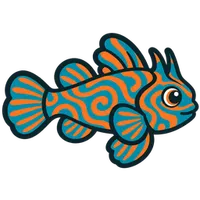
The mandarin dragonet (Synchiropus splendidus) is a living watercolour — and a fish that quietly starves in most tanks. It's a micro-predator that eats tiny live copepods all day, so it thrives only in a mature reef with a thriving pod population (ideally a refugium) — or as a captive-bred fish already trained onto frozen food. Get the feeding right and it's peaceful and hardy; get it wrong and it slowly wastes away.
Care at a glance
| Adult size | Small — about 3 in (7.5 cm). |
|---|---|
| Minimum tank | A mature 30+ gallon reef with lots of live rock — but tank size isn't the real issue: the food supply is. A mandarin can starve in a 100-gallon tank as easily as a 10-gallon if the pods run out. |
| Temperature | 75–82°F (24–28°C). |
| pH | 8.1–8.4. |
| Specific gravity | 1.020–1.026 (≈35 ppt; keep it stable). |
| Other targets | Lots of live rock to hunt over; a refugium/pod culture is the single best thing you can add. Ammonia/nitrite 0, nitrate low. |
| Diet | Micro-predator — it grazes tiny live copepods and amphipods off the rock all day. Two paths to success: (1) an established, pod-rich mature tank (ideally with a refugium and regular live-pod top-ups), or (2) a CAPTIVE-BRED mandarin already trained onto frozen (mysis, brine, micro-pellets). Wild-caught fish often refuse anything but live pods. |
| Temperament | Peaceful, slow-moving, even timid — easily out-competed for food, so it needs calm, non-greedy tankmates. Males are territorial toward other males/dragonets. |
| Reef-safe | Yes — reef-safe with soft, LPS and SPS corals. |
| Natural range | Pacific reefs. |

The fish store gets these wrong
Common myths, kindly corrected — no shame for having believed them.
- “A mandarin will be fine in any established reef.” Only if it's pod-rich. Mandarins eat live copepods constantly; without a big, replenishing pod population (a refugium helps hugely) they slowly starve, even in a large, clean tank.
- “It's a hardy nano fish because it's small.” Its small size is misleading — the challenge is a constant live-food supply, not tank volume. Feeding, not gallons, is the hurdle.
- “You can't get one to eat frozen.” You can now — captive-bred mandarins are widely available already trained onto frozen food, which turns this from an expert-only fish into a doable one.
Before you buy
- Buy CAPTIVE-BRED, trained onto frozen — the single biggest thing that makes a mandarin succeed.
- Add it only to a mature, pod-rich reef (ideally with a refugium); top up live pods.
- Keep tankmates calm — it can't compete with greedy fish.
- Watch its belly (see below) — a thinning mandarin is a feeding emergency.
Quarantine and get help if…
We can't diagnose from a photo — but these are the signs to stop watching, quarantine, and get an aquatic vet or an experienced reefer's eyes on it:
- A pinched-in, hollow or narrowing belly, or a visibly thinning body — the classic sign it isn't finding enough food; act now (add pods / target-feed / move it to a pod-rich tank).
- White salt-grain spots, flashing, or rapid gill-breathing (mandarins have a thick mucus coat and get ich less often, but it happens).
- Sitting listless, not hunting, clamped fins, or gasping.
- Any new fish added without quarantine.
Print the Mandarin Dragonet emergency vet-prep card — what to bring, what to tell the vet, and the questions to ask.
Never
- Never add a mandarin to a new or pod-poor tank.
- Never assume a big tank alone is enough — it's about food.
- Never house it with greedy, fast tankmates that outcompete it.
- Never buy a wild-caught mandarin if a captive-bred (frozen-trained) one is available.
Common mandarin dragonet questions
Why do mandarin dragonets starve, and how do I prevent it?
Mandarins are micro-predators that eat tiny live copepods all day. In a tank without a big, replenishing pod population they slowly starve — even a large, healthy-looking tank. Prevent it by buying a captive-bred mandarin already trained onto frozen, and keeping it in a mature, pod-rich reef (a refugium helps enormously).
Should I buy a captive-bred mandarin?
Yes, strongly. Captive-bred mandarins are widely available already eating frozen foods (mysis, brine, micro-pellets), which makes them far easier and more sustainable than wild-caught fish that often refuse anything but live pods.
What size tank does a mandarin dragonet need?
A mature 30+ gallon reef with plenty of live rock — but tank size isn't the real issue. A mandarin can starve in a 100-gallon tank as easily as a 10-gallon if it runs out of food, so a thriving pod supply matters more than gallons.
Are mandarin dragonets reef-safe?
Yes — they're peaceful and reef-safe with soft, LPS and SPS corals. They spend the day hunting pods over the rock and leave corals alone.
Do I need a refugium for a mandarin?
Not strictly required, but it's the single best thing you can add — a refugium continuously breeds the copepods a mandarin eats. Combined with a captive-bred, frozen-trained fish, it's the reliable path to a healthy mandarin.
🐚 Did you know? — Mandarin Dragonet fun facts
Little true delights about the mandarin dragonet — each one checked against a named source, no reef-store folklore.
- The mandarin dragonet is one of only two known vertebrates whose blue colour comes from a true blue pigment cell called a cyanophore, rather than the light tricks that make almost every other blue animal blue. Wikipedia
- A mandarin dragonet has no scales at all, wearing instead a slippery, bitter-smelling slime coat that helps fend off disease and discourage predators. Wikipedia
- The mandarin dragonet gets its name from its dazzling colours, said to recall the ornate robes of an Imperial Chinese mandarin. Wikipedia
Sources & further reading
This guide was written and fact-checked against these authorities. It's honest, general guidance — not a diagnosis, and not a substitute for an aquatic vet or your own test kit:
- Bulk Reef Supply — How To Care For Mandarin Dragonets — tank size, water, pods/refugium, starvation risk, captive-bred/frozen training, temperament, reef-safe
- Tropical Fish Hobbyist — A Mandarin Diner — feeding/copepod ecology, starvation risk, husbandry
Written and fact-checked by The Coralkin Team against marine-aquarist and veterinary sources — if your mandarin dragonet shows a red-flag sign above, quarantine and get an aquatic vet or an experienced reefer's eyes on it. We never guess a care number.
🔬 Review status: team-written and fact-checked against cited sources · not yet reviewed by a marine vet. How we research & fact-check →
Get the free Mandarin Dragonet Starter Kit
A readiness checklist and a first-30-days plan to set up your mandarin dragonet the right way — every number drawn straight from our fact-checked care sheet. Join the shoal and we’ll send it over.
Honest reef care straight to your inbox. No spam — unsubscribe anytime. See how we handle your data in our privacy notice.