
Firefish Goby
Nemateleotris magnifica
An elegant, peaceful hover-fish with a flame-orange tail — perfect for nano reefs.
Difficulty: Beginner Reef-safe community fish Reef-safe
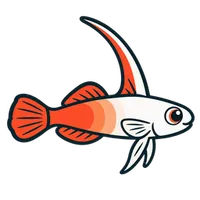
The firefish (Nemateleotris magnifica) is an elegant, peaceful hover-fish — white up front, flame-orange at the tail, with a flicking dorsal fin. It's perfect for a nano reef and utterly reef-safe. The catch: it's a champion jumper, so a tight lid isn't optional.
Care at a glance
| Adult size | Small — about 2–3 in (5–8 cm). |
|---|---|
| Lifespan | About 3 years. |
| Minimum tank | A 20–30 gallon reef (commonly kept in nanos); moderate flow and rockwork to bolt into. |
| Temperature | 75–82°F (24–28°C). |
| pH | 8.1–8.4. |
| Specific gravity | 1.020–1.026 (≈35 ppt; keep it stable). |
| Other targets | Give it a rockwork retreat/burrow; keep nitrate low. |
| Diet | Planktivore — frozen mysis and brine shrimp, blackworms, and prepared marine foods; small feeds a couple of times a day. |
| Temperament | Peaceful and rather timid toward other fish — but territorial toward its own kind. Keep one, unless you have a proven bonded pair. |
| Reef-safe | Yes — leaves corals and inverts alone. |
| Natural range | Indo-Pacific reefs. |

The fish store gets these wrong
Common myths, kindly corrected — no shame for having believed them.
- “A little gap in the lid is fine.” Not for a firefish — they slip through surprisingly small openings. You need a tight-fitting lid or mesh over every gap.
- “Keep a few for a shoal.” No — firefish are territorial with their own kind. Keep a single unless you buy a proven bonded pair.
Before you buy
- Seal the tank — a tight lid or mesh over every opening.
- Add it among peaceful fish; it's timid and gets outcompeted by boisterous tankmates.
- Give it rockwork to dart into.
- One firefish (or a bonded pair only).
Quarantine and get help if…
We can't diagnose from a photo — but these are the signs to stop watching, quarantine, and get an aquatic vet or an experienced reefer's eyes on it:
- White salt-grain spots, flashing, or rapid gill-breathing (possible ich or velvet).
- Cloudy skin patches, clamped fins, or gasping at the surface.
- Refusing food and hiding for days, or a hollow belly.
- Any new fish added without quarantine.
Print the Firefish Goby emergency vet-prep card — what to bring, what to tell the vet, and the questions to ask.
Never
- Never run an open-top tank with a firefish — it will jump.
- Never keep two (non-bonded) firefish together.
- Never house it with aggressive or boisterous fish that bully it off its food.
- Never add it to an uncycled tank.
Common firefish goby questions
Do firefish jump?
Yes — notoriously. Firefish are among the most enthusiastic jumpers in the hobby and slip through small gaps. A tight-fitting lid or mesh cover over every opening is essential.
Can I keep more than one firefish?
Only a proven bonded pair. Firefish are territorial toward their own kind, so two unbonded fish usually fight — keep a single otherwise.
Are firefish reef-safe?
Completely. They leave corals and invertebrates alone and are a classic peaceful nano-reef fish.
What size tank does a firefish need?
A 20–30 gallon reef is plenty, and they're commonly kept in nanos. Give them rockwork to bolt into and, above all, a sealed lid.
How long do firefish live?
Around 3 years is typical in the aquarium.
🐚 Did you know? — Firefish Goby fun facts
Little true delights about the firefish goby — each one checked against a named source, no reef-store folklore.
- The firefish hovers just above the seabed facing into the current, waiting for tiny drifting invertebrates to arrive. Wikipedia
- A firefish constantly flicks its very long first dorsal fin back and forth as a signal to other firefish. Wikipedia
- Firefish are monogamous, living in sandy burrows alone or in pairs and darting back inside the moment they feel threatened. Wikipedia
Sources & further reading
This guide was written and fact-checked against these authorities. It's honest, general guidance — not a diagnosis, and not a substitute for an aquatic vet or your own test kit:
- Saltwater Aquarium Blog — Saltwater Firefish Goby Care Guide — adult size, lifespan, tank size, diet, temperament, reef-safe, jumping, range
Written and fact-checked by The Coralkin Team against marine-aquarist and veterinary sources — if your firefish goby shows a red-flag sign above, quarantine and get an aquatic vet or an experienced reefer's eyes on it. We never guess a care number.
🔬 Review status: team-written and fact-checked against cited sources · not yet reviewed by a marine vet. How we research & fact-check →
Get the free Firefish Goby Starter Kit
A readiness checklist and a first-30-days plan to set up your firefish goby the right way — every number drawn straight from our fact-checked care sheet. Join the shoal and we’ll send it over.
Honest reef care straight to your inbox. No spam — unsubscribe anytime. See how we handle your data in our privacy notice.