
Blue-Leg Hermit Crab
Clibanarius tricolor
The reef's tiny janitor — grazes hair algae and detritus all day; just give it spare shells.
Difficulty: Beginner Cleanup crew Reef-safe
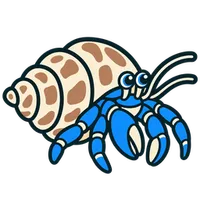
The blue-leg hermit crab (Clibanarius tricolor) is the reef hobby's default cleanup hermit — a thumbnail-sized scavenger with blue legs that picks hair algae, detritus and leftover food off the rock all day. It's cheap, hardy and genuinely useful. The one catch is shells: a hermit that outgrows its home will kill a snail to steal one — so keep a pile of spare empty shells and the peace holds.
Care at a glance
| Adult size | Small — around 0.5 in (1–1.5 cm). |
|---|---|
| Minimum tank | Any established tank; stock modestly (roughly 1 per 5–10 gallons). |
| Temperature | 75–82°F (24–28°C). |
| pH | 8.1–8.4. |
| Specific gravity | 1.023–1.026 (reef-standard ≈35 ppt). |
| Other targets | Standard reef calcium and alkalinity support healthy moulting; like all inverts it has zero tolerance for copper. |
| Diet | Scavenger — hair algae, detritus, leftover food, and some film algae and cyanobacteria. Supplement with a little dried algae in a very clean tank. |
| Temperament | Peaceful toward corals and fish — but will kill snails for their shells if it's short of a home. |
| Reef-safe | Yes — leaves corals alone. The only risk is to snails (for shells), which spare shells prevent. |
| Natural range | Caribbean / Western Atlantic. |

The fish store gets these wrong
Common myths, kindly corrected — no shame for having believed them.
- "Hermit crabs are pure reef janitors with no downside." Mostly true — except they'll kill a snail for its shell when they outgrow their own. Spare shells fix it.
- "One hermit per gallon, like the old rule." No — that overstocks and starves them. A handful for a nano, scaled up modestly.
- "Any shell will do." Never use painted or land-snail shells — provide clean marine shells in a range of sizes.
Before you buy
- A handful of spare empty marine shells in assorted sizes — the single most important thing.
- An established tank with some algae and detritus to graze.
- Stock modestly — a few for a nano, not dozens.
- Drip-acclimate; never any copper.
Signs something's wrong
A struggling invert is usually telling you about water quality, acclimation, or (for shrimp and crabs) a fresh moult — here's what to watch for:
- A dead snail with a hermit now in its shell — shell shortage; add spare shells.
- A hermit out of its shell or a discarded shell — usually a moult or shell change (normal), but check it has options.
- Missing limbs after a moult — usually a nutrition or chemistry issue.
Work through the Blue-Leg Hermit Crab trouble card — the water, light, flow and pest checks that fix almost every struggling invert.
Never
- Never keep hermits without spare empty shells — they'll take a snail's.
- Never use painted shells.
- Never dose copper with inverts in the tank.
- Never drop them straight in — drip-acclimate.
Common blue-leg hermit crab questions
Are blue-leg hermit crabs reef-safe?
Yes — they graze algae and detritus and leave corals alone. The only real risk is that they'll kill a snail to steal its shell if they outgrow their own, so keep a supply of spare empty marine shells.
Why did my hermit crab kill my snail?
Almost always a shell shortage. As hermits grow they need bigger shells, and a desperate hermit will evict (and kill) a snail to take one. Keep a handful of assorted empty shells in the tank and it rarely happens.
How many blue-leg hermits should I add?
Modestly — the old "one per gallon" rule overstocks and starves them. A handful for a nano, scaled up gently for larger tanks, matched to how much algae and detritus you actually have.
What do blue-leg hermit crabs eat?
Hair algae, detritus, leftover food and some film algae and cyanobacteria. In a very clean tank, drop in a little dried seaweed or sinking food so they don't go hungry.
Do I need to feed hermit crabs?
In a stocked tank they usually find enough. If the tank is very clean or you keep several, supplement with a bit of dried seaweed or sinking food.
🐚 Did you know? — Blue-Leg Hermit Crab fun facts
Little true delights about the blue-leg hermit crab — each one checked against a named source, no reef-store folklore.
- Blue-leg hermit crabs sport striking blue legs marked with red banding between each segment. Wikipedia
- They graze together in loose groups much like grazing cattle, all drifting in one general direction as they feed from dusk through the night. Wikipedia
- This species engages in shell fighting, where one crab flips a rival onto its back and repeatedly bangs its shell down until the loser is evicted from its home. Wikipedia
Sources & further reading
This guide was written and fact-checked against these authorities. It's honest, general guidance — not a diagnosis, and not a substitute for an aquatic vet or your own test kit:
- Reef Cleaners — Blue Leg Hermit Crab — diet, reef-safe, cleanup role
- Foxy Saltwater Tropicals — Saltwater Hermit Crabs Care Guide — shells, snail predation, stocking
- AlgaeBarn — All About Saltwater Tank Crabs — reef-safe behaviour, care
Written and fact-checked by The Coralkin Team against marine-aquarist sources — if your blue-leg hermit crab is struggling, it's almost always water quality, acclimation or a moult — check those first and ask an experienced reefer. We never guess a care number.
🔬 Review status: team-written and fact-checked against cited sources · not yet reviewed by a marine vet. How we research & fact-check →
Get the free Blue-Leg Hermit Crab Starter Kit
A readiness checklist and a first-30-days plan to set up your blue-leg hermit crab the right way — every number drawn straight from our fact-checked care sheet. Join the shoal and we’ll send it over.
Honest reef care straight to your inbox. No spam — unsubscribe anytime. See how we handle your data in our privacy notice.